We all like to think we are rational decision-makers. Yet, in higher education, cognitive biases can systematically distort how we grade, how we interpret feedback, and how we relate to one another.
I am excited to announce the open access publication of our latest study, “Mitigating cognitive biases in higher education contexts through a brief video-based intervention,” in the journal Computers & Education.
https://doi.org/10.1016/j.compedu.2025.105535
Here is a look at what we did, what we found, and why it matters.
The Approach: Moving Beyond Games and Checklists
The existing literature on debiasing often presents a dilemma. On one hand, simple “awareness” trainings are easy to deploy but often fail because people struggle to recognize bias in real-time. On the other hand, metacognitive interventions that aim to enhance self-correction, such as immersive “serious games” are effective but are too resource-intensive to implement broadly.
Our study introduces a more scalable, structural solution. We developed brief, scenario-based videos (micro-interventions) that do more than just inform. They are designed to modify the cognitive structure of the decision-maker. By presenting a scenario and then explicitly providing an alternative outcome, the intervention disrupts what is called “focal bias” (Stanovich, 2009)—the tendency to get stuck on an initial mental model—and trains the viewer to actively generate alternative possibilities.
Findings (#1) – It Works (for teachers or under the right conditions for students)
We conducted a randomized controlled trial with 1,038 participants (teachers and learners) across multiple countries, targeting 21 distinct biases.
| Bias Name | Bias Description |
|---|---|
| Authority Bias | Conforming to opinions and recommendations of people who are considered authoritative figures |
| Group Attribution Error | Attributing characteristics, behaviors, or traits to a group of individuals collectively |
| Reactive Devaluation | Devaluing an offer, proposal, or idea solely due to its association with an outgroup or a disliked individual. |
| Curse of Knowledge | The difficulty of empathizing with someone less informed to effectively communicate information or instructions |
| Negativity Bias | Paying more attention to, remembering, and being influenced by negative information rather than positive information |
| Bandwagon Effect | Adopting to a belief or a behavior because it is the popular choice |
| Fundamental Attribution Error | Overemphasizing personal characteristics in explaining others’ behavior, while downplaying or neglecting contextual factors |
| Pygmalion Effect | High/low expectations from others leading to enhanced/poorer performance or behavior |
| Reactance | When instructed (not) to do something, feeling compelled to do the opposite to reassert control and independence. |
| Dunning-Kruger Effect | Tendency of individuals with limited ability or expertise in a domain to overestimate their competence. |
| Mere Exposure Effect | Developing a preference for things or people through repeated exposure even in the absence of additional positive attributes. |
| Optimism Bias | Under/overestimating likelihood of negative/positive events or outcomes |
| Hyperbolic Discounting | Tendency to prefer smaller, immediate rewards over delayed, larger rewards |
| Continued Influence Effect | Tendency for previously learned false information to continue influencing decisions even after being corrected |
| Halo Effect | Thinking someone is intelligent, kind or benevolent because they are physically attractive |
| Functional Fixedness | Reduced ability to perceive or consider alternative uses or functions for an object beyond its typical purpose |
| Illusion of Transparency | Overestimating the extent to which their own thoughts feelings are “transparent” to others. |
| Misinformation Effect | Inclination to integrate new incorrect information about a event into one’s memory of the event |
| Status Quo Bias | Preferring to maintain the current situation, even when objectively better alternatives are available |
| Gender Bias | Unequal treatment or favoritism based on a person’s gender |
| Social Comparison Bias | Having negative and competitive feelings towards someone because one perceives them to be better than oneself |
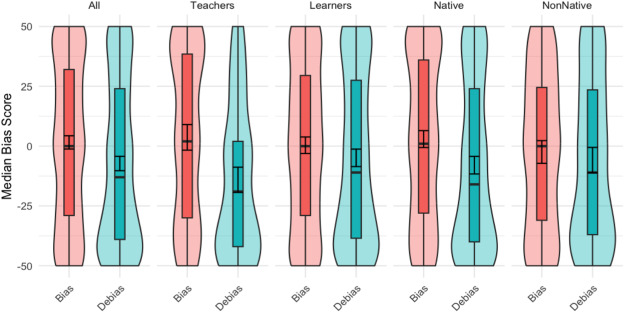
- Effectiveness: The debiasing videos significantly reduced the likelihood of biased decisions. The intervention was far more powerful for teachers (Cohen’s $d=0.51$) compared to learners (Cohen’s $d=0.11$). This suggests that professional experience or cognitive maturity may enhance one’s receptiveness to this type of structural training.
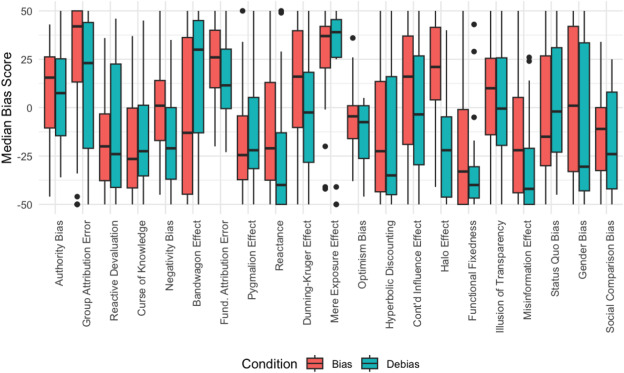
- Below are the (1) comparison of control (bias) vs. intervention (debias) conditions and (2) the bias-wise comparison of the effects.
Findings (#2) – We Potentially Have “Transfer Effect”: The Holy Grail of Debiasing
One of the hardest things to achieve in bias mitigation is the “transfer effect”. In this context, transfer isn’t just about learning to spot a specific bias; it is about whether reducing an individual’s susceptibility to one bias creates a ripple effect, lowering their susceptibility to other, completely different biases. We tested if the structural change in decision-making—specifically, the ability to generate alternative scenarios—would carry over to new situations.
- The Finding: We found that teachers successfully demonstrated this transfer effect. After receiving the intervention for one specific bias, they showed reduced bias in subsequent tasks involving completely different biases. This is a promising sign that brief interventions can help cultivate a generalized “mindware” for better decision-making.
Findings (#3) – Context is Key: The Role of Language
We also tested the “Foreign Language Effect”—the theory that using a non-native language creates emotional distance that reduces bias. Our results contradicted this theory in the context of our intervention. For students, the debiasing tools were effective only when delivered in their native language. This may mean that cognitive strain can hinder processing of the debiasing information. To be effective, micro-interventions for students must be linguistically accessible and engaging, ensuring they fully grasp the alternative scenarios presented.
Resources for Educators
This publication is one of the outputs of the DBIAS (De-Biasing in Higher Education) project. We also have translated these findings into practical tools for the classroom.
- Visit the Project Website: https://dbias.eu/home/
- Download Free Teaching Strategies: Access the videos and exercises used in our study here: https://dbias.eu/teaching-strategies/
Supplementary files and data available from: https://osf.io/mr4at/overview?view_only=952b02ecb314484789e708ec78244842
Disclaimer: Featured image generated by Gemini. Post language has been edited using Gemini.
 LemiBaruh..Portal
Leave a comment